Predictive Maintenance for Chemical Plant Equipment
Using Machine Learning to Predict Failures and Minimize Downtime
Project Goal
This project focuses on developing a predictive maintenance system for centrifugal pumps in the chemical industry. By leveraging machine learning and real-time sensor data, the system predicts potential equipment failures before they happen.
The primary objectives are to optimize maintenance schedules, significantly reduce costly unplanned downtime, and enhance operational safety and efficiency.
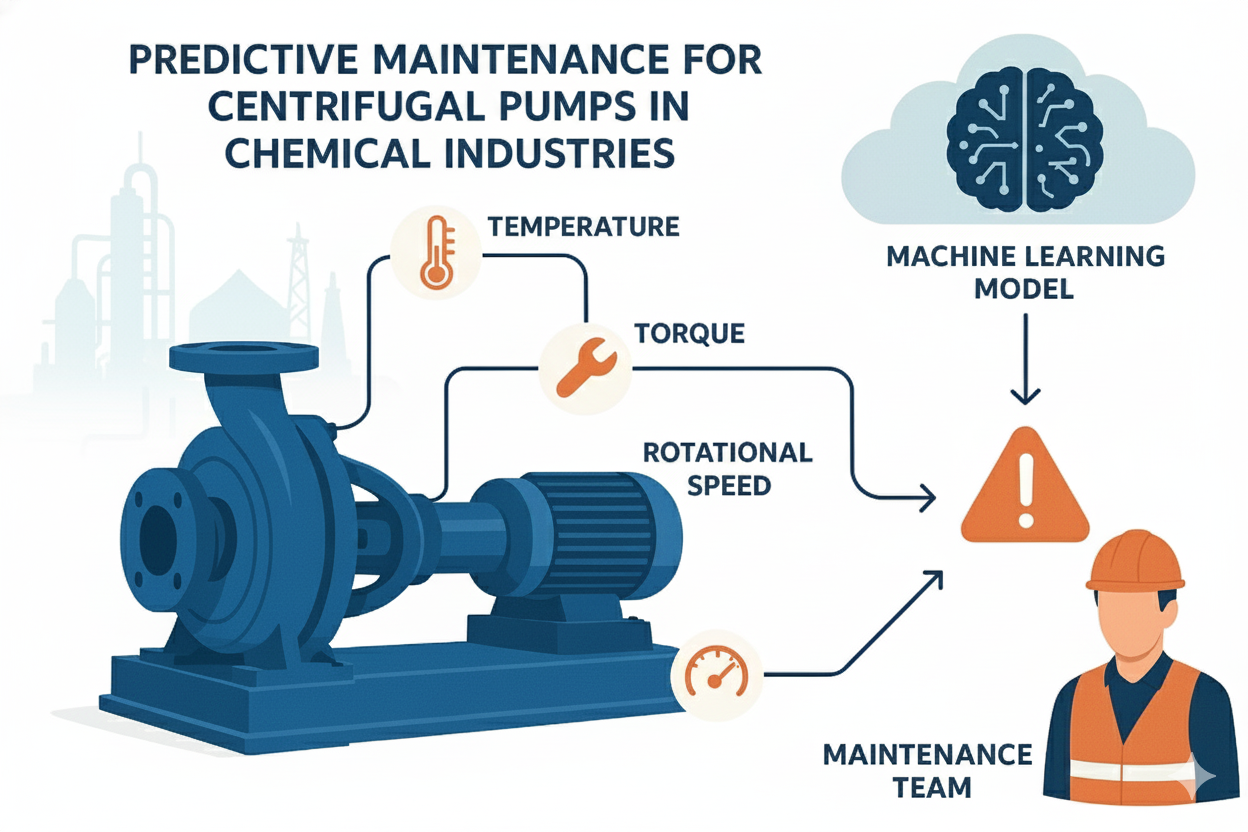
Dataset & Key Parameters
Temperatures
Air Temperature [K] and Process Temperature [K] are monitored to detect overheating or operational deviations.
Mechanical Stress
Rotational Speed [rpm] and Torque [Nm] provide insights into the mechanical strain on the pump and motor.
Component Wear
Tool Wear [min] tracks the cumulative operational time, a key indicator for wear-and-tear related failures.
Failure Types Analyzed
The model is trained to predict not just if a failure will occur, but also the type of failure, including: Power Failure, Tool Wear Failure, Overstrain Failure, and Heat Dissipation Failure.
System Workflow
Real-Time Data Collection
Live sensor data (temperature, torque, speed) is continuously collected from the pump.
Model Prediction
The machine learning model processes this data in real-time to predict the probability of failure.
Anomaly Detection
The system compares predictions against a healthy baseline. Any deviation triggers a warning.
Actionable Alerts
If a potential failure is detected, an alert is sent to the maintenance team, detailing the potential issue (e.g., "Warning: Torque spike indicates a potential blockage").
Tech Stack
Impact & Conclusion
This project demonstrates a practical application of machine learning to solve a critical industrial problem. By shifting from a reactive ("fix it when it breaks") to a proactive maintenance strategy, chemical plants can significantly improve equipment reliability, increase operational uptime, and enhance workplace safety.