Thermodynamic Modelling of Gas Hydrates
A Hybrid Machine Learning & Molecular Simulation Approach
Project Abstract
This project addresses the critical industrial challenge of predicting gas hydrate formation, which can cause pipeline blockages and significant safety hazards. We developed a novel, two-part machine learning framework that is both computationally efficient and thermodynamically consistent.
The core innovation is a hybrid system that simultaneously predicts the macroscopic equilibrium pressure of hydrate formation and the microscopic absolute cage occupancy of gas molecules — a fundamental property for stability that traditional ML models often overlook.
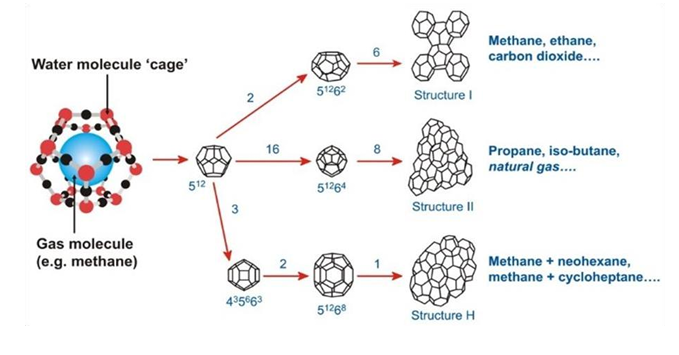
Project Objectives
Phase 1: Pressure Prediction
Develop an ML model to accurately predict the equilibrium pressure of hydrate formation using temperature and gas composition data.
Phase 2: Occupancy Prediction
Use Grand Canonical Monte Carlo (GCMC) simulations to generate a reliable dataset for gas molecule occupancy and train a second ML model to predict it.
Key Results
Pressure Prediction Model Performance
0.98
(Test R² Score)
Occupancy Prediction Model
The XGBoost model demonstrated high accuracy in predicting fractional occupancies, closely matching values from GCMC simulations.
Ongoing & Future Work
- Multi-Component Systems: Extend simulations to ternary and quaternary mixtures to improve industrial applicability.
- Inhibitor Effects: Incorporate the effects of thermodynamic inhibitors (e.g., methanol, salts) into the models.
- Develop a User-Friendly Tool: Package the hybrid model into a lightweight Python library or a web-based application for broader use.